What are tampons made of?

The objective of this article is to answer all your questions about tampons, their manufacturing process, and their composition. If you have any more questions, do not hesitate to get in touch with us and we will get back to you.

We understand that you want to take good care of yourself. From the food you eat to the personal products you use; safety is a big factor for all women.

Here at Tampax, we absolutely agree with you. This is of utmost importance both for our users and also for our female engineers at Tampax, who are not only researchers but above all women.

We share product safety assessments with scientists, healthcare professionals, and health authorities to ensure our products can be used safely. In addition, our products are tested by OEKO-TEX® STANDARD 100, one of the most stringent certifications for harmful substances.

The manufacture of tampons is not overly complex: each component selected meets a unique need and is always certified by independent experts to ensure its safety.

Check out the table below to learn which components and materials are included in our tampons and why..

ComponentBenefits
RayonNatural-based fibres (wood pulp) that help absorb and retain liquids
CottonNatural fibres that help absorb and retain liquids
PolypropyleneSynthetic fibres that help channel fluid back to the core
PolyethyleneSynthetic fibres that enable smooth removal
PolyesterThread that sews tampon together

Our purification process ensures Tampax tampons are made without elemental chlorine bleaching and do not add any perfume to the tampon.
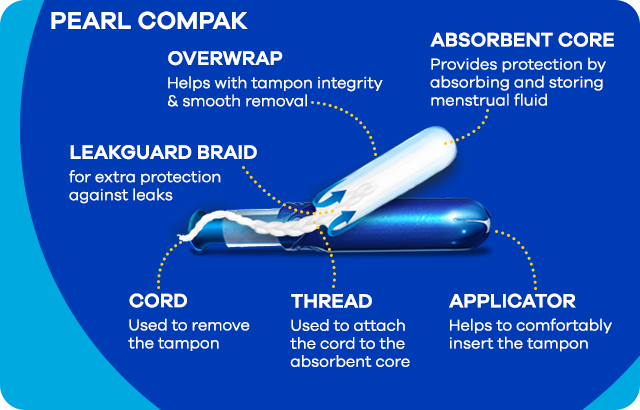
Composition of Tampax Pearl Compak tampons

SMOOTH REMOVAL LAYER:
The smooth removal layer is made of synthetic fibres like polyethylene and polypropylene. These fibres are often used in technical sport clothes and help here with smooth removal.

ABSORBENT CORE:
The core is made of cotton and rayon. The cotton comes from sustainable suppliers. It’s a plant-based ingredient purified for usage. Rayon is a material derived from purified wood pulp and is processed into an absorbent cellulose fibre. Rayon is a common component, used in tea bags for example.

THREAD:
The thread is made of synthetic fibres like polyester that sew the tampon together.

STRING:
The string is made of cotton and synthetic fibres like polypropylene. They help attach the string to the core of the tampon and help channel fluid back to the core.

APPLICATOR:
Tampax plastic applicators are made without BPA and designed to make insertion easy and smooth.

Do you want to know more about the specific composition of your Tampax tampon?

Tampax TamponsCOMPOSITION
Tampax Cardboard (Regular/Super/Super Plus)Rayon, polyester and cotton.
Tampax Compak (Light/Regular/Super/Super Plus)Rayon, polyester and cotton.
Tampax Pearl (Light/Regular/Super/Super Plus/Super Plus Extra)Rayon, cotton, polypropylene, polyethylene, and polyester.
Tampax Pearl Compak (Regular/Super/Super Plus)Rayon, cotton, polypropylene, polyethylene, and polyester.
Tampax Cotton Protection (Regular/Super)100% organic cotton core, polypropylene braid, polyester thread.

Have a look at this video to understand our approach to ingredient safety.

Tampax tampons are safe to use

Every woman wants the best for her body. That is why Tampax is here to reassure you that our tampons are safe to use.

Each component is evaluated before being used in our tampons: more than 1,000 quality tests are conducted on raw materials.

We share our safety assessments with scientists, healthcare professionals and authorities to ensure that our products can be used safely. We also work with independent organisations, who perform more than 10,000 tests per year on our tampons and their components. These experts confirm that our tampons and the substances used in their manufacture are safe to use.

In addition, our products are tested by OEKO-TEX® STANDARD 100, one of the most stringent certifications for harmful substances. To learn more about OEKO-TEX®, visit their website.

Hygienic protection

Many consumer associations and governmental institutes have tested the safety of feminine hygiene products in recent years. It should be noted that all of these tests (Que Choisir, DGCCRF in France but also in Switzerland) have verified the safety of these products. Likewise, ANSES carried out a quantitative assessment of skin health risks. “It concluded that there was no health risk in tampons, sanitary napkins and/or pantyliners – whether these chemicals were detected or quantified.” – ANSES, Safety of intimate protection products, June 2018.

It is true that these same studies have occasionally reported the presence of traces of potentially toxic substances. These are only present in trace amounts, can be found anywhere in the environment, and are considered safe for human use by experts. What is more, we want to assure you that we do not use any of these substances and never intend to do so. All of our components are selected and evaluated in a rigorous way, and our products exceed comply with the strictest regulations in all countries in which we manufacture and sell our tampons, often going above and beyond the legal requirements.

13 questions about the components of our tampons and their functionality

All Tampax products meet rigorous safety and effectiveness STANDARDs, regardless of what they are made from. Our tampons are designed to provide an optimal level of protection and comfort. Using both cotton and rayon helps us deliver tampons that meet all these needs. Tampax has been offering cotton, rayon, or blended cotton and rayon products since we were founded in 1936. Tampax offers tampons with an absorbent backing in cotton, rayon or a cotton-rayon blend. Since 2020, the Tampax range has grown with Tampax Cotton Protection, tampons with a 100% organic cotton core, without perfume or dye.

The cotton used in Tampax products is supplied by a privately owned family company founded 116 years ago in the United States. The cotton produced is purified without chlorine and is natural, soft and absorbent. This company is a member of Cotton LEADS™, a program committed to growing cotton responsibly. Based on core principles consistent with sustainability, use of best practices, and supply chain traceability, the Cotton LEADS™ program offers cotton users the confidence and certainty that their raw material is produced in a responsible and traceable manner. The cotton used by Tampax is OEKO-TEX® STANDARD 100 certified, one of the most stringent certifications for harmful substances.

No, they do not. Tampax plastic applicators are made from BPA-free plastic.

No, our tampons do not contain any ‘super-absorbent’ material.

No, the absorbent materials in Tampax are produced using a single purification process without any elements of chlorine. The purification of raw materials is sometimes referred to as bleaching because it has the effect of whitening the natural color of the raw material, but this is only the result of the purification of the fiber and not the intended result. There are several methods to purify rayon (i.e. regenerated cellulose from wood pulp) and cotton: Before the 90s, elemental chlorine was commonly used for purification in many industries, but this releases dioxins. This technique is no longer used today. ECF Elementary Chlorine Free: A chlorine dioxide-based method (without elemental chlorine) that does not release dioxins during the cellulose purification process. This is used by 95% of the industry as well as in our core Tampax product lines. TCF Totally Chlorine Free: To compensate for the lack of chlorine dioxide, the TCF method increases the amount of hydrogen peroxide added. This is the method used by 5% of the industry and is found in Tampax Cotton Comfort. Studies by other experts have shown no significant difference between the two technologies (ECF and TCF) when the best available techniques are used. No measurable levels of dioxin are present with ECF or TCF.

Bleaching is the technical term for fibre cleaning and purification. Purification of cotton and rayon is carried out to eliminate the impurities and clean the fibres. Whitening of the fibres is a result of this process, but not its goal.

No, the purification of cotton and rayon involves an elemental chlorine-free process which does not create dioxin. The FDA has addressed this topic on their website. Please visit their tampon information at this website.

Yes. Based on the most advanced testing methods approved by government authorities, we are confident that the purification methods we require from our suppliers do not lead to the formation of dioxin (or any of the 17 dioxin congeners) in our products.

Trace chemicals are chemicals found in very small quantities (1 per billion or even 1 per trillion) that can sometimes be detected in products by using very advanced extraction methods. Such techniques, though effective, do not reflect the real conditions of daily use by consumers. For example, these tests often use chemical solvents that are not found on human skin or break down products into several different components.

Used tampons and pads, like most personal hygiene or medical care products, cannot be recycled or flushed down the toilet. We have therefore designed our products in such a way that they can be disposed of with household waste. We want to help women know what to do with their used products. It is clearly stated on all packaging that our products cannot be flushed down the toilet – you will find more information on this in the short guide included in each box. Throw your tampon in the bin after use. It’s much better for the environment – we promise.

Yes, Tampax tampons contain plastic materials. The use of plastic in our products allows us to make products with high level of quality, protection and comfort that make our brand your preferred choice. Protection and reassurance against leaks are a priority for us. Be also reassured that the presence of plastic (polypropylene, polyethylene, and polyester) in the tampons, wrappers and applicators are proven to be safe. In fact, these are the same materials used in medical bandage, clothes and garments. Also, the Plastic applicator is BPA-free and Tampax cardboard tampons come with a non-plastic applicator. The safety of all Tampax tampons has been confirmed by independent experts and is certified OEKO-TEX® STANDARD 100.And please always remember: Don’t flush tampons, tampon applicators or wrappers down the toilet! This can block the pipes and could also end in unintended environments. Throw them in the trash instead.

OEKO-TEX® is an independent certification body for textile products in raw, semi-processed or finished states at all production levels. Manufacturing equipment is also tested. OEKO-TEX® is an independent certification body and is completely independent from manufacturers and public bodies. OEKO-TEX® STANDARD 100 has screened all the components of Tampax tampons (absorbent core, outer layer, removal cord, sewing threads and applicator) to detect the potential presence of unwanted substances. All Tampax products have been tested, verified, and certified. OEKO-TEX® tests the presence of more than 1000 substances: OEKO-TEX® STANDARD 100 of considers the legislation in force but goes even further by testing certain substances that are not yet regulated. This label is thus a valuable complement to regulations, which Tampax already follows. The list of criteria is updated every year. The OEKO-TEX® STANDARD 100 requirement is not limited to one test: in addition to the first laboratory tests, OEKO-TEX® STANDARD 100 not only performs random checks on store-bought Tampax tampons and even performs verification checks in the factories where they are manufactured. To learn more about OEKO-TEX®, visit their website

Tampons can be used safely! Many everyday items may contain trace levels of metals, which are naturally occurring in the Earth's crust and can be absorbed by plants as they grow. These can occasionally be detected in products like tampons using very sensitive analytical equipment. But rest assured, the trace amounts of metals that could be found in a tampon is very small – not unlike the low amounts found in the food and water we consume every day. Since these trace amounts can be found everywhere in the environment, regulatory bodies like the European Union and renowned agencies like the World Health Organization (WHO) set allowable limits for things like drinking water to drive exposure to as low as reasonably achievable.